Some of us appreciate the labour that goes into reinventing things: the thought and effort that makes something out of very little.
So this bit of engineering is outstanding: it might be a competitor in Scrapheap Challenge, but this is designed to do a job of work and go on doing it. The engine is Chinese. The chassis is made up by the smithy across the road, and the drive train, which is driven by a large alternator belt, is made up of parts from a car. It has little in the way of suspension: just a tractor front end with an articulated beam for the wheels. It is, in a world where very little goes to waste, impressive.
Saturday, 30 January 2016
Disability is not inability
The VI Unit![]() |
| Braille paper took two and a half months to arrive here. It came by air freight from the UK. The hold up was in customs clearance. It is, after all, only paper. The freight company waived the charges. Visual impairment is often absolutely dependent on braille. The mural in the background helps us to see what they could be doing, but the VI students aren't all able to see it. A partially sighted student helps to unpack the new batch of braille paper. |
About five per cent of the students at Mvumi Secondary School are visually impaired. That means that they have difficulty seeing.
The doctor went through the list of five in Form 1 (year 8 in the UK) who have just joined the school.
“She can see with one eye - well enough with glasses.”
“He needs dark glasses. He had his eyes removed a few years ago and has conjunctivitis. He must continue to learn braille.”
“She must continue learning braille - her eyesight is deteriorating and there isn’t anything that can be done.”
In their classroom they bump into things: us, for example. We are standing where they expect a space.
These students want music and aural things. They want maps and bones shapes that they can touch. They want simple maths but they aren't taught it.
They are always at the end of a list: sometimes they are taught with blackboards they can’t see, and with books they can’t read so they have to rely on someone to read for them so that they can take notes with a braille machine, have the notes printed on braille paper and then read them themselves.
So they do badly in exams.
They are, by and large, at the end of the money list.
Thursday, 28 January 2016
About the weather and loads of rain
It rained this afternoon (30th January) in huge bucketfuls and the ground outside was like a lake. 24ºC, but it felt a little cool.
Tanzania lies not far from the equator, and well inside the Tropic of Cancer. The sun is never far from overhead, and summer and winter don't really apply. It does get cooler in September, and during the rainy season the temperatures fluctuate between about 27º and 35º during the day.
If you compare Dodoma, our nearest city, with Gravesend in the UK which has scored both the hottest and the coolest days from time to time, there is one thing that always stands out - just how regular, like a heartbeat, the diurnal temperature and pressure is. It goes up during the day, and down during the night, regular as clockwork.
These are from Wunderground, from 28th January 2016.
Tanzania lies not far from the equator, and well inside the Tropic of Cancer. The sun is never far from overhead, and summer and winter don't really apply. It does get cooler in September, and during the rainy season the temperatures fluctuate between about 27º and 35º during the day.
If you compare Dodoma, our nearest city, with Gravesend in the UK which has scored both the hottest and the coolest days from time to time, there is one thing that always stands out - just how regular, like a heartbeat, the diurnal temperature and pressure is. It goes up during the day, and down during the night, regular as clockwork.
These are from Wunderground, from 28th January 2016.
GRAVESEND:
and DODOMA:
Saturday, 23 January 2016
Monday, 18 January 2016

The great event some days is the rain, which comes down rather vertically and with little or no breeze. It just pours. So far it has poured for twelve hours, and then last night for about five hours. The noise is almost frightening because there is so much of it on the tin roofs around the village. It can fill a bucket in about five minutes, but the ground just soaks it up.
Walking down to the bridges a day or two after shows the rivers still full, but unless it rains again they will become dry and the intensely coloured water will be gone.


The goats eat fearlessly - these thorns (a bit fuzzy at this magnification) will stab you and make you bleed. They have evolved to keep everything away from them, including goats, who somehow evolved a bit more thoughtfully and can strip the leaves off without damaging themselves.Further down is an old style mud building. The bricks are made from mud and sun dried, and then mortared together using more mud. The roof is made by laying straight timbers - branches - across the front and back walls, and then laying straw or banana leaves, and then mud. Plants grow in the mud.
When mangoes are picked, it isn't by a specially designed mango harvester. The lads climb the trees, which are huge, spreading and the same shape as oak trees, and they pick the mangoes. From there they go to the market. If you look at the picture there is a lad in the left hand tree calling out "Mzugu!
The river is not in full flood, but the water is loaded with silt. This will settle to replace the silt that has been washed further down by the rain. The colour of the water is like paint.
Friday, 15 January 2016
Cats, dogs and guinea fowl.
The cats here roam day and night, eating insect and lizards and tiny rodents. They are skinny and swaybacked and have nothing of the complacent indifference of a domesticated cat.
They have a dim light of survival in their eyes that are too dark to reflect the beautiful stars.
At night they meet and fight among themselves, their thin bones scraping at each other with claws and ugly yells and howls and teeth.
The dogs are black or tan, their tails curl a little over their backs. They seem all to be of the same mould apart from the colour, and are lean and fit except for the ones who have mange or distemper. Sometimes they lie in the shade while the fleas are quiet, or they flicker along the roads and paths with a sense of purpose, or prowl the market place near the meat stall looking for scraps.
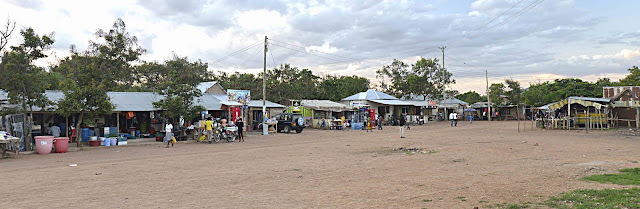
On the dry sandy road with the deep puddle opposite the school, a small hen with four chicks stops at the side of the road. She waits. When the road is clear she runs, and the chicks follow, all five running across to the shelter of the fence on the other side.
A motorcycle comes by.
Three mango sellers sit by the roadside, talking. They have picked green mangoes. All fruit ripens here.
The oranges are green like wild oranges, with patches of orange. The bananas grow deep green and ripen on the bush. A banana doesn’t grow on a tree, because it isn’t member of the family of trees. Who cares? It looks like a tree, you can make a waterproof roof with the leaves, and if it isn’t a tree, what on earth is a paw-paw? A long, emaciated stalk with a bad haircut at the top, and little nodules of wonderful fruits underneath.
The roosters, not regulated by an electronic signal from Rugby or Frankfurt, begin crowing at around 4.30am, before the muezzin’s first call of the day. Sunrise is usually around 6am. The sun rises very quickly. It hangs around heating up the ground until about 6pm, when it sets very quickly.
The village is busy from 5am or earlier.
On the sandy street in the square are the buses, the budda-budda bikes, the water seller, the charcoal seller, and the little shops that sell everything, make all the clothes, make the livings.
The water seller has a tricycle with the back platform loaded with ten litre plastic bottles of water; frayed and worn plastic, discoloured by use and ultra violet. A man loads long timbers onto his motorbike. There is music already.
Thursday, 14 January 2016
TV with mosquitoes
Tonight, 14th January 2015, two, or maybe three, mosquitoes watched an episode of Lewis in which a very rich man confined to a wheelchair was found to be responsible for the death of his wife’s mother who was a prostitute, not the wife, the mother.
The mosquitoes whined about the plot, and I gave them a shot of stuff in a brightly coloured aerosol which smells like cauterising fluid.
They stopped whining.
Our water supply has been problematic. There is a large one and a half tonne tank of water on a pedestal that is supposed to be filled by a pump that resides somewhere near the generator, at the head of a borehole. The pump had lost its grunt, and the school administrator has had someone dig a trench to find the pipework for this, in the ‘shamba’ or garden where those lovely bananas are ripening and from which we have a paw-paw, or papaya, for our dessert this evening.
The roots of a cactus (I believe) were found to have strangled the pipe.
Agnes is cooking supper. She comes in every day to clean out the dust and wash the clothes.
The dust is prevalent. When it first rained last week, quite heavily but briefly, on going out to leave a bucket to fill with rain water, the ground was already dry, scatter with the marks of raindrops.
The dust is from a sand which is mostly a sort of quartz type grain, some big, but most of it small, without the gentler profile of beach sand: a bit grittier. If you have sandals that are worn at the point where they hinge most, sand will gather in that patch and help to keep the skin of your feet tender. Which is why I’m wearing shoes today.
Constant power outages since last Wednesday 6th afternoon, mostly because an articulated lorry, foolish enough to brave these roads, had approached the corner a little too loosely and taken out the bottom of the four power cables that hang slack across the road outside the hospital. It turned out that this was the school’s supply cable, and the event took place not long after the beginning of school. The cottage we stay in has a secondary system of solar charged lights, with a dedicated electronic thingie and a battery. It looks quite Maplin, but is very effective.
We listen to the BBC World Service when the power is down. It reminds me of childhood when we listened to Lourenço Marques Radio on shortwave in the 49 metre band so that we could hear Buddy Holly and Elvis. The signal would fade in and out according to the sunspots and we would maybe practise a bit of jive.
Monday, 11 January 2016
Power outages
![]() |
| In the office. The fan isn'g going round because there's a power cut. |
It rained last night, from about 1am until about 1pm today, without stopping. No breezy showers, breaks in the sky. Rain, steady, wet, moderately warm and saturating. creating puddles.
![]() |
| That gorgeous green open land, palm trees and baobabs. Heat like a frying pan. |
Great butterflies here. Flocks that flutter around you and follow each other.
Will go to the village and buy a decent chip for the dongle. Maybe we'll be able to download something.
Monday, 4 January 2016
A very simple lesson
Shkamon mzee.
This is a greeting to an older person. It is respectful.
The reply is
Marhaba: the 'h' is pronounced in an Arabic way, at the back of the throat, a glottal 'h'.
You could also say
hu jambo. More or less 'how's things?'
Habari - How are you. Also Yako. The reply might be Nzuri.
Salaam is another general greeting. It sounds Arabic because the Arabs traded the coastline of Africa for a long time.
Habari asubuhi - good morning. Pronounce the second word asuboy.
Habari za mchana - good afternoon.
Habari za jioni - good evening.
In the street a white person may be greeted:
Mzungu. Or if there are two or more of you, Wa Mzungu.
For the young ones, you could say
Mambo? Something like How's it going?
The reply may be Poa (pronounced almost like poor): it means something like I'm cool.
Karibuna is the plural of Karibu: they both mean welcom.
And if someone knocks at the door - you say Hodi?
This is a greeting to an older person. It is respectful.
The reply is
Marhaba: the 'h' is pronounced in an Arabic way, at the back of the throat, a glottal 'h'.
You could also say
hu jambo. More or less 'how's things?'
Habari - How are you. Also Yako. The reply might be Nzuri.
Salaam is another general greeting. It sounds Arabic because the Arabs traded the coastline of Africa for a long time.
Habari asubuhi - good morning. Pronounce the second word asuboy.
Habari za mchana - good afternoon.
Habari za jioni - good evening.
In the street a white person may be greeted:
Mzungu. Or if there are two or more of you, Wa Mzungu.
For the young ones, you could say
Mambo? Something like How's it going?
The reply may be Poa (pronounced almost like poor): it means something like I'm cool.
Karibuna is the plural of Karibu: they both mean welcom.
And if someone knocks at the door - you say Hodi?
Homesick?
I've not been homesick since the weary days of boarding school. It was a happy event this time: I love our new home in Tollesbury, but being in Tanzania is turning out very well after the trial by journey.
Today began with a staff meeting: the meeting about the big things for the whole year. Most of it was in Swahili: it was two hours long. Just like a staff meeting in a UK school.
The air is dry, but there are storms each day - a bit of rain, some humungous clouds, a bit of thunder and lightning. Most of the day there is a breeze.
This evening we may watch one of the DVD's left by Brian and Aleen who were the Bursar's Department before arrived. There is a complete set of Harry Potter, whole sets of Foyle's War and Lewis (Alison likes these)(yes, I do too), and lots of films.
The sitting room is very comfortable: the windows are always open, with mosquito screens and burglar bars. It doesn't stop them getting in, but the mosquito nets over the beds are the protection at night, along with whatever malaria drug you might be taking. The mosquitoes, I mean. Don't know about the burglars.

The ground outside is flat and sandy. There are lizards and space age wasps, sparrows and short sharp birds, ones that argue and ones that shout. There are bananas, pawpaws, capsicums, and even grapes in the garden, at the front a bougainvillea and cactus.
There is no hot water except from the kettle. Showers are cold, not icy. The loos need flushing with a good bucketful because the cisterns can't deliver. There isn't a water shortage, but the borehole pump stops working when there is a power outage.
The floor is smooth cement, and cool. The curtains dance up and down at night as the breeze comes and goes.
Sunset happens in about 25 minutes. The shadows begin to stretch out, and before you know it it is dark. The sky is black and stars are brilliant.
At night there is noise from the town square, people mixing, taken in by the music and the food, and later the Muezzin calling to prayer. And again at 5am.
At lunch today we had rice and beans with a topping of onion. Very tasty. We had tea with it.
I had a lesson in Kiswahili.
Today began with a staff meeting: the meeting about the big things for the whole year. Most of it was in Swahili: it was two hours long. Just like a staff meeting in a UK school.
The air is dry, but there are storms each day - a bit of rain, some humungous clouds, a bit of thunder and lightning. Most of the day there is a breeze.
This evening we may watch one of the DVD's left by Brian and Aleen who were the Bursar's Department before arrived. There is a complete set of Harry Potter, whole sets of Foyle's War and Lewis (Alison likes these)(yes, I do too), and lots of films.
The sitting room is very comfortable: the windows are always open, with mosquito screens and burglar bars. It doesn't stop them getting in, but the mosquito nets over the beds are the protection at night, along with whatever malaria drug you might be taking. The mosquitoes, I mean. Don't know about the burglars.
The ground outside is flat and sandy. There are lizards and space age wasps, sparrows and short sharp birds, ones that argue and ones that shout. There are bananas, pawpaws, capsicums, and even grapes in the garden, at the front a bougainvillea and cactus.There is no hot water except from the kettle. Showers are cold, not icy. The loos need flushing with a good bucketful because the cisterns can't deliver. There isn't a water shortage, but the borehole pump stops working when there is a power outage.
The floor is smooth cement, and cool. The curtains dance up and down at night as the breeze comes and goes.
Sunset happens in about 25 minutes. The shadows begin to stretch out, and before you know it it is dark. The sky is black and stars are brilliant.
At night there is noise from the town square, people mixing, taken in by the music and the food, and later the Muezzin calling to prayer. And again at 5am.
At lunch today we had rice and beans with a topping of onion. Very tasty. We had tea with it.
I had a lesson in Kiswahili.
Sunday, 3 January 2016
Getting there
On the 31st December 2015 I left my phone in the car. Left the car in the garage.
The garage is 4000 miles away, so text messages have been routed via Alison's phone.
England blew us across the North Sea in a gale, and we rose from Schiphol in a Dreamliner for a sleepless night to Nairobi.
When the sun rose, Kenya welcomed us. The connection for Dar Es Salaam was a rush past Kilimanjaro into the humid city. The plastic bottles and bags lined the streets, and the traffic danced around to a peculiar music of its own.
We took a taxi to the MIC Hotel near the bus station. Air conditioning dripped down the power conduit in the bathroom, down the back of the sink, on to the floor. I stood in it, barefoot, brave and exhausted.

In the morning the Shabiby coach took us the eight hour journey to Dodoma, way up in the middle of Tanzania. The driver talked on his phone, spoke with a voice so rapid he sounded like a machine, and steered the bus with his elbows when he needed to change gear and talk on the phone. Our progress was rapid.Francis, the head of the school, met us at the bus station, and we had lunch at the Dodoma Hotel, opposite the station.
![]() |
| The earth is red and the trees and grass are green. The rainy season has begun. |
Monday, 28 December 2015
My husband, Hugh Morrison, and I are both looking forward to our time in Mvumi. We should be arriving at Mvumi from UK on 1st January, so our 2016 will be spent in Tanzania.
Today I gave the twelve new teachers I had been working with in London, UK, the information about both DCT Mvumi Secondary School and the Trust, for which, from the beginning of January, we will be working as volunteers.
I have also posted the same information to all those who contact me via my email account with Canterbury Christ Church University, in Canterbury, UK.
It would be wonderful if in the future friends from UK are able to visit Mvumi; I do hope that this will be the case.
Dr Alison Leonard/ Mrs Morrison
Today I gave the twelve new teachers I had been working with in London, UK, the information about both DCT Mvumi Secondary School and the Trust, for which, from the beginning of January, we will be working as volunteers.
I have also posted the same information to all those who contact me via my email account with Canterbury Christ Church University, in Canterbury, UK.
It would be wonderful if in the future friends from UK are able to visit Mvumi; I do hope that this will be the case.
Dr Alison Leonard/ Mrs Morrison
Monday, 30 November 2015
Slideshow of the school
This is the slideshow, below, that Brian has put up - for November 2015. This is DCT Mvumi Secondary School.
https://youtu.be/0dGongHb6Sw
"As the year draws to an end and the Mvumi School Trust representatives from UK are ending their term of office, at DCT Mvumi Secondary School there are new beginnings! Young students, fresh from Primary school, attend the Pre-Form 1 induction course and work on the much-needed Science laboratory is now starting".
https://youtu.be/0dGongHb6Sw
"As the year draws to an end and the Mvumi School Trust representatives from UK are ending their term of office, at DCT Mvumi Secondary School there are new beginnings! Young students, fresh from Primary school, attend the Pre-Form 1 induction course and work on the much-needed Science laboratory is now starting".
Saturday, 28 November 2015
Dates
We depart on 30th December 2015 - we'll be back briefly on 3rd June until about the 16th, then again in December, and will have one short visit in 2017.
This is exciting: although Hugh was born and brought up in South Africa, Africa is a huge place. It is the second biggest continent.
First will be the long ride out there under the stars, then the journey from Dar es Salaam to Dodoma by bus.
This is exciting: although Hugh was born and brought up in South Africa, Africa is a huge place. It is the second biggest continent.
First will be the long ride out there under the stars, then the journey from Dar es Salaam to Dodoma by bus.
Tuesday, 17 November 2015
December 2015
In January 2016, Alison and Hugh will be in Mvumi, Tanzania.
We will be working for the Mvumi Trust which is based in the UK and helps fund students through their secondary education at Mvumi Secondary School. The Mvumi Secondary School website is here:
The Mvumi Trust site is here: http://mvumischooltrust.org.uk
We will be working for the Mvumi Trust which is based in the UK and helps fund students through their secondary education at Mvumi Secondary School. The Mvumi Secondary School website is here:
Subscribe to:
Posts (Atom)


